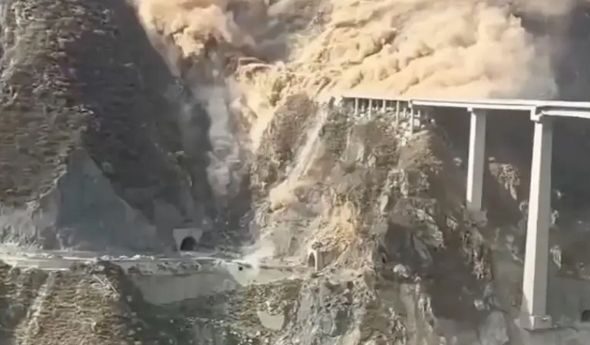
A shocking incident unfolded in China’s Sichuan province on Tuesday, November 11, when the newly constructed Hongqi Bridge, a major infrastructure project connecting central China to Tibet, partially collapsed. The dramatic moment was captured on video and has since gone viral on social media, showing massive slabs of concrete plunging into the river below as a thick cloud of dust filled the air.
A Major Structural Failure Shakes Sichuan
According to Chinese state media, the Hongqi Bridge—spanning approximately 758 meters—was part of the G317 national highway in Maerkang city. Authorities had reportedly closed the bridge on Monday evening after detecting cracks and ground shifts, just hours before the collapse occurred.
The proactive shutdown prevented what could have been a catastrophic loss of life. Local officials told Reuters that no casualties have been reported so far.
Videos circulating online show the bridge collapsing suddenly, with concrete beams breaking apart and crashing into the gorge below. The footage, shared widely on Weibo and X (formerly Twitter), has sparked widespread discussion about China’s infrastructure safety and construction standards.
Early Investigation Points to Geological Instability
Initial investigations indicate that geological instability in the steep mountainous region may have triggered the collapse. The Sichuan Daily reported that officials had identified potential risks on the right bank of the Hongqi Bridge section during an inspection at 5:25 PM (local time) on Monday. This led to an emergency evacuation and closure of the site.
The collapse reportedly took place around 3:00 PM local time on Tuesday, near the Shuangjiangku Hydropower Station and dam, where the bridge stood an astonishing 625 meters above the gorge floor.
Authorities have launched a comprehensive technical probe to assess whether design flaws, construction errors, or geological factors contributed to the incident.
A Symbol of Progress Turned Tragic
Completed earlier this year, the Hongqi Bridge was celebrated as a symbol of modern engineering excellence. It was officially opened to the public in September 2025, aiming to improve connectivity between Sichuan province and the Tibetan Plateau, a region known for its challenging terrain and seismic activity.
However, just two months after its opening, the bridge’s collapse has raised serious concerns about construction oversight and safety evaluations in China’s rapid infrastructure expansion drive.
Highway Remains Closed, Probe Underway
In the aftermath, the entire section of the G317 national highway near Maerkang remains closed. According to China Daily, there is no confirmation yet on when the route will reopen to the public.
Chinese authorities have vowed to conduct a full-scale safety assessment of nearby bridges and tunnels to prevent similar incidents.
Chinese Engineering Failure- The 758-metre-long Hongqi bridge collapsed in southwest China, months after opening. China isn’t as smart as everyone makes them out to be. They couldn’t copy this design. The ground shifted on one of the approaches. Luckily it was noticed the day… pic.twitter.com/ZJDDdwgCP9
— Peter Lemonjello (@KCtoFL) November 11, 2025
Public Reaction and Broader Implications
The collapse has sparked an outpouring of reactions on Chinese social media platforms, where users have expressed both shock and frustration. While many praised the authorities for preventing casualties through timely closure, others demanded greater transparency and stricter construction regulations.
The Hongqi Bridge incident serves as a sobering reminder of the challenges of building large-scale infrastructure in geologically unstable areas, and highlights the importance of sustained monitoring even after project completion.
In Summary:
-
Incident: Partial collapse of Hongqi Bridge in Sichuan, China
-
Date: November 11, 2025
-
Length: 758 meters
-
Casualties: None reported
-
Cause (preliminary): Geological instability
-
Status: Closed; investigation underway
The world watches as China, known for its engineering marvels, investigates how one of its newest bridges could fall so soon after its grand opening — a stark reminder that even modern megastructures remain at the mercy of nature’s power.